WHAT THE OPTIMIZER IS
The Home Care Inside™ Optimizer is an executive-level diagnostic and operating framework designed specifically for home care agencies delivering short-visit services inside Independent Living communities.
It provides leadership teams with an objective way to evaluate their Home Care Inside operation — not just how busy it feels, but how well it actually works.
Unlike traditional assessments that assume long, one-to-one visits, the Optimizer is purpose-built for fractional, team-based, on-site care models, where caregivers deliver many short visits during a single shift.
The Optimizer is:
- Not software
- Not a generic assessment
- Not a sales pitch
It is a decision-making framework designed for agency owners and operators.
WHY THE OPTIMIZER EXISTS
Short-visit care inside Independent Living behaves very differently than traditional home care.
Many agencies struggle not because there is a lack of demand, but because:
- Paid caregiver time is not aligned with delivered care
- Scheduling changes consume excessive administrative time
- Pricing and service rules don’t match how care is delivered
- Caregivers struggle to operate as a coordinated team
- Leadership lacks clear visibility into utilization and profitability
- Demand inside the community slowly erodes over time
Agency owners often describe the challenge simply:
“I can’t make the math work.”
The Optimizer exists to replace guesswork and assumptions with structure, metrics, and clarity — before costly decisions are made.
HOW THE OPTIMIZER WORKS
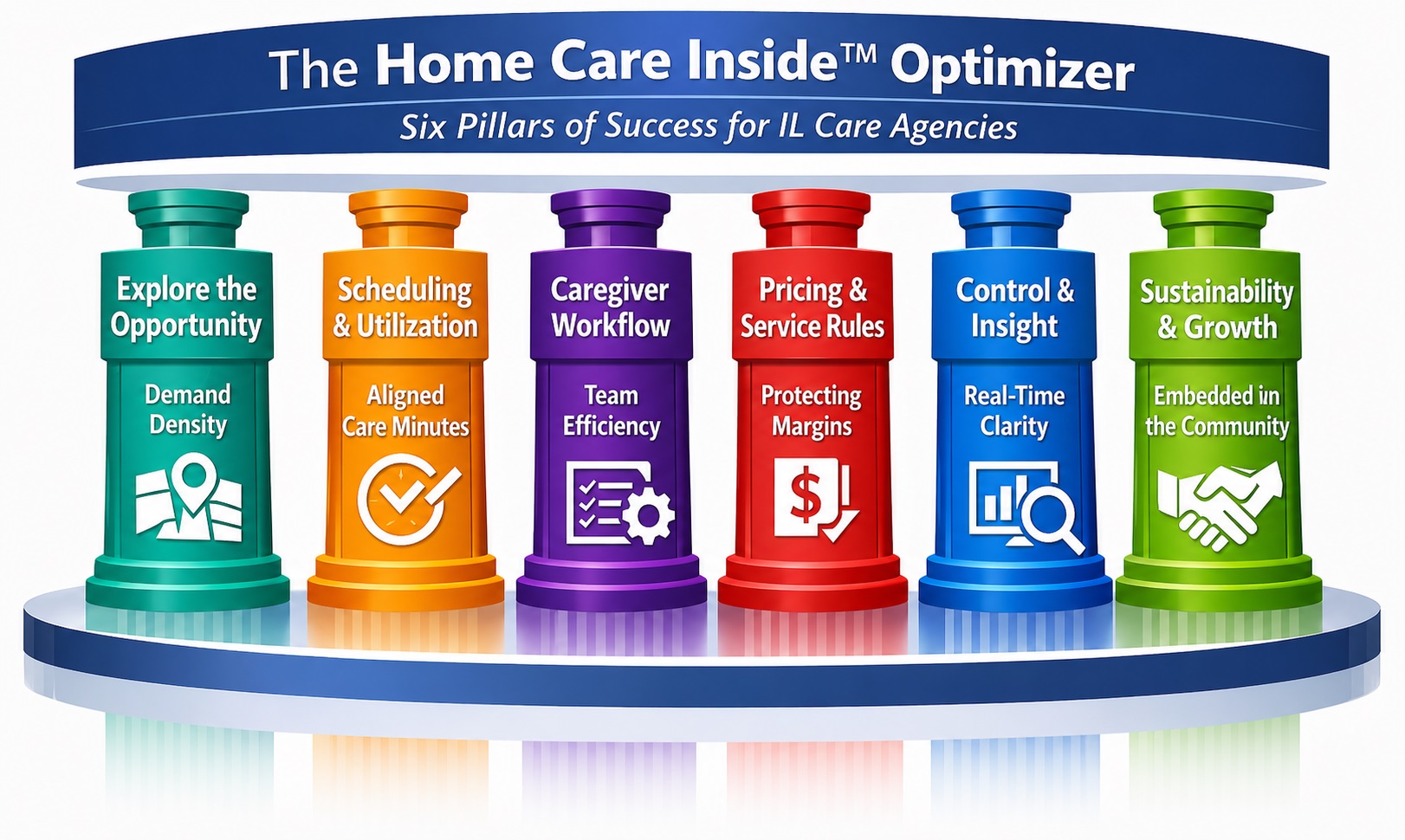
The Home Care Inside IL Optimizer evaluates your operation across six critical pillars that determine whether short-visit care inside IL can succeed and scale.
Each pillar is scored, revealing where your operation is strong, where it is fragile, and which constraints must be addressed first.
The Six Pillars:
1. Explore the Opportunity
Enough client visits, at the right timesBefore optimizing staffing, scheduling, or pricing, agency leaders must determine whether the Independent Living community can realistically support a short-visit care model.
This pillar evaluates:
- The size and maturity of the community
- The number of residents receiving short-visit and long-visit services
- Whether demand is concentrated in predictable time windows
- Competitive dynamics and preferred-provider status
- Whether the community dictates on-site coverage requirements
The goal is not to assess performance yet — but to answer a foundational question:
Is there enough opportunity, in the right structure, to justify an on-site short-visit care team?
2. Scheduling & Utilization
Paid time aligned with scheduled servicesThis pillar measures how effectively paid caregiver shift time converts into actual client care minutes.
It evaluates:
- Total scheduled visit minutes versus paid shift minutes
- Daily and average caregiver utilization rates
- How staffing levels are adjusted based on utilization data
Strong performance here indicates that staffing decisions are being driven by demand — not habit, convenience, or community pressure.
How effectively does paid caregiver shift time convert into actual client care minutes?
3. Caregiver Workflow
Team-based execution rather than individual silosShort-visit care succeeds only when caregivers operate as a coordinated team.
This pillar evaluates whether:
- Visits are scheduled based on time and location
- Caregivers can easily adjust when schedules change
- Mobile documentation supports real-time execution
- Processes are defined and repeatable — not dependent on specific people
Can caregivers execute care as a coordinated team, even when schedules change?
4. Pricing & Service Rules
Revenue that matches operational realityThis pillar evaluates whether pricing, minimums, and service policies protect margin in a short-visit environment.
It assesses:
- Visit pricing methodology (time, task, packages)
- Minimum visit or weekly service requirements
- Policies for unscheduled time and visit changes
- Gross profit performance at the community level
The intent is to ensure that revenue models reflect how care is actually delivered — not how agencies wish it worked.
5. Control & Insight
Leadership visibility and accountabilityThis pillar evaluates whether leadership has real-time visibility into:
- Caregiver utilization
- Gross profit by community
- Revenue trends and forecasts
- Overall profitability of short-visit operations
Does leadership have real-time visibility into utilization, cost, and profitability by community?
6. Sustainability & Growth
Opportunity is systemic, not accidentalThis pillar evaluates whether demand inside the community is sustained through structure — not informal relationships.
It assesses:
- Involvement in the community’s sales and prospect process
- Inclusion in standard marketing materials
- Participation in resident and community events
- Whether referrals follow a defined process
Is your agency embedded in the community’s sales and marketing process, or is demand dependent on informal referrals and historical momentum?
Five pillars determine whether the model works today. The sixth determines whether it continues to work tomorrow.
WHAT AGENCIES GAIN
The Optimizer is designed to give agency leadership clarity before action.
After completing the Optimizer, agency leaders can confidently answer:
- Is our Home Care Inside IL operation profitable?
- Where is margin leaking — and why?
- Are we staffed efficiently for short-visit demand?
- Are our pricing and service rules helping or hurting us?
- Is demand inside the community stable, fragile, or growing?
- What should we fix first to improve results?
This clarity allows agencies to:
- Focus improvement efforts where they matter most
- Avoid unnecessary staffing or technology changes
- Strengthen relationships with IL partners
- Protect and grow preferred-provider status
- Build a sustainable Home Care Inside model
WHO THIS IS FOR
This Is a Good Fit If:
- You deliver short-visit care inside Independent Living communities
- You are responsible for operational performance and profitability
- You want objective insight, not opinions
- You believe Home Care Inside must be intentionally designed to work
This May Not Be a Fit If:
- You only provide traditional long-hour private duty
- You are unwilling to examine operational and financial reality
- You expect short visits to succeed without structure
Get Optimized
Short-visit care inside Independent Living cannot be managed by instinct alone.
The Home Care Inside Optimizer is a 15-minute diagnostic designed for agency owners and operators who want objective clarity on utilization, profitability, workflow, pricing, and long-term sustainability.
If you cannot confidently answer whether your IL model is working, this is the place to start.
➡️ Get Optimized